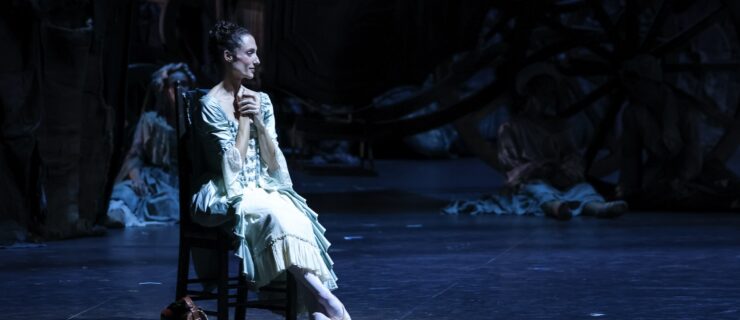
The Joffrey Ballet Performs John Neumeier’s Prized—and Complicated—Liliom

Choreographer John Neumeier says his interest in “the outsider” is what draws him to dark stories—like Liliom, the 1909 play by Hungarian playwright Ferenc Molnár that inspired Rodgers and Hammerstein’s musical Carousel. Liliom was first imagined as a ballet by Neumeier in 2011, for Hamburg Ballet, where he was artistic director and principal choreographer for over 50 years. Now, the Joffrey Ballet opens its 2026–27 season this month as the first North American company to perform Liliom. It runs September 17–27 at Chicago’s Lyric Opera House.
As in Carousel, Neumeier shifts his ballet’s setting from turn-of-the-century Budapest to a Great Depression–era American fairgrounds, where carnival barker Liliom (whose job is to entice prospective fairgoers to “step right up”) experiences deep hardship and a gradual fall from grace. The ballet deals with difficult topics, including suicide and domestic abuse—subjects Neumeier says dance should not shy away from.
“What ballet is about, all the time, is our common humanity,” Neumeier says in a phone call with Pointe. “I think this is part of our human nature that we are not perfect. It’s this imperfection that interests me.”
A Significant Staging
Stagings of Neumeier’s works have cropped up all over the U.S., but Liliom is one the choreographer has kept close to the vest. Hamburg Ballet performed it exclusively for several years, both at home and across the globe (including in California in 2014, to recognize Liliom composer Michel Legrand’s film and television catalog).
“I wanted to keep certain works exclusive to the Hamburg Ballet,” Neumeier says of his decision. “This is why a company is invited to tour, because it has a repertoire that no other company has.”
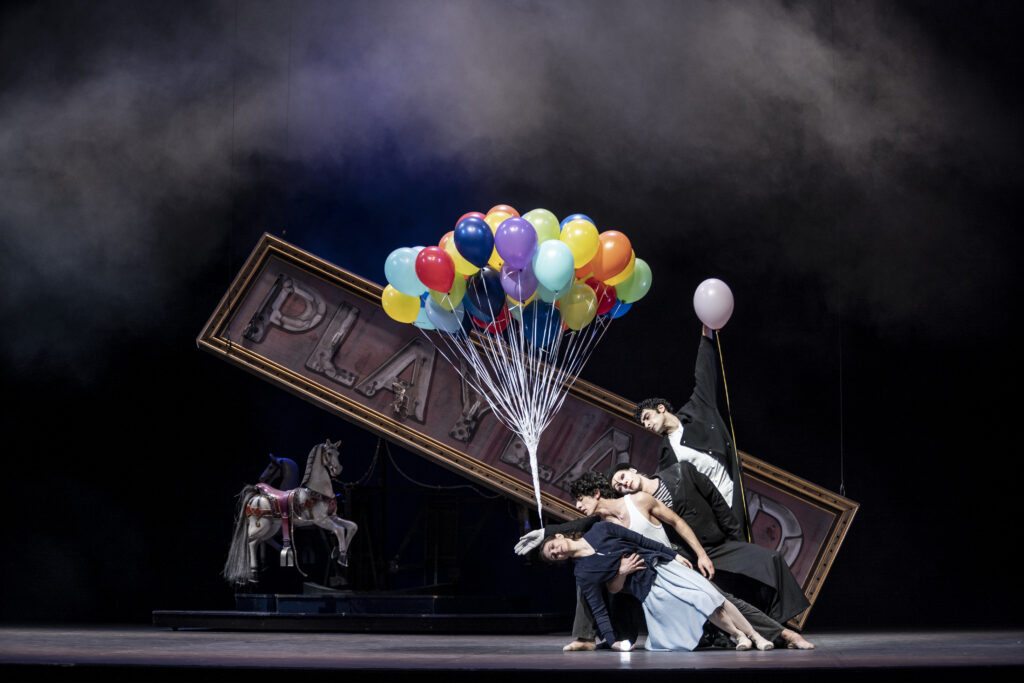
Joffrey artistic director Ashley Wheater attended the 2011 premiere in Hamburg and started asking for it “almost immediately,” Neumeier says. Czech National Ballet performed Liliom last fall in Prague. Joffrey is now just the third company to present it.
A Milwaukee native whose formative dance training took place in Chicago, Neumeier says nostalgia was only part of the decision to give Liliom to the Joffrey.
“It sounds a bit banal, but I think it’s a very interesting company,” he says. “I feel they are constantly developing. The ballet masters [from Hamburg staging Liliom] have been so impressed with the concentration and the energy that the company has given to the work.”
A Complicated Subject Matter
In 2017, New York Times critic Siobhan Burke’s review of Alexei Ratmansky’s Odessa, performed by New York City Ballet, sparked a nationwide discussion about whether it is necessary or responsible for ballets to continually expose audiences, never mind performers, to the subjugation of women.
In Liliom, the protagonist falls in love with Julie, a maid, who becomes pregnant. Liliom struggles to find enough work to support their child, embarking on a failed robbery and, in his deep frustration, resorting to physical violence.
“I do not see Liliom as a wife beater,” Neumeier says. “I see him as a very disturbed man who has a great talent to seduce in his career as a carousel caller. But in his core, I think he is very insecure and very sensitive. He just loses it.”
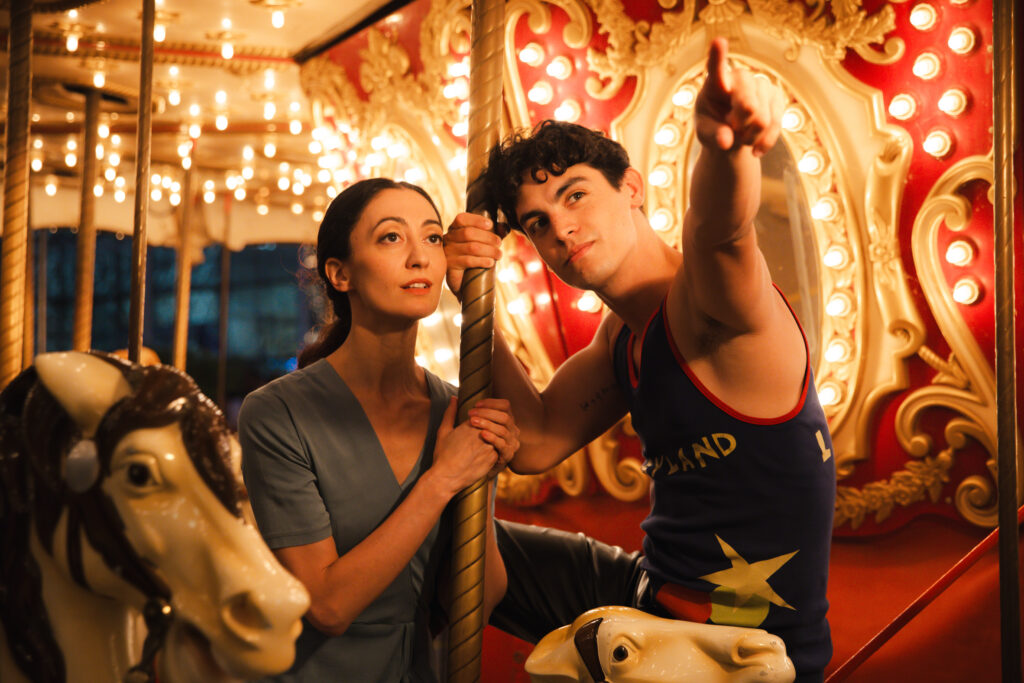
As Julie, leading Joffrey dancer Victoria Jaiani says her character sees the good sides of Liliom, who in her cast will be danced by José Pablo Castro Cuevas. Though Julie is not naïve to Liliom’s many failings, she chooses to stay by his side.
“Listen, I don’t always agree with my characters or see eye to eye,” Jaiani says. “But in order to be honest onstage, I have to have the ‘whys’ and the ‘whats.’ ”
It’s not the first imperfect character Jaiani has tackled in over 20 years with the Joffrey, especially in darker tales. (Her depictions of Carmen, Anna Karenina, and Frankenstein’s Elizabeth come to mind.) Jaiani’s first time working with Neumeier was in 2015, as Diana for Joffrey’s U.S. premiere of his Sylvia. More recently, she danced Eurydice in his Orphée et Eurydice and the title role in a sardonic, opposite-of-Disney retelling of Hans Christian Andersen’s The Little Mermaid.
“These are all women that are strong in their own right to make the choices they make,” Jaiani says. “That’s what makes this job so interesting: that we get to tell these stories. Some are just a bit more complicated than others.”
Building Trust
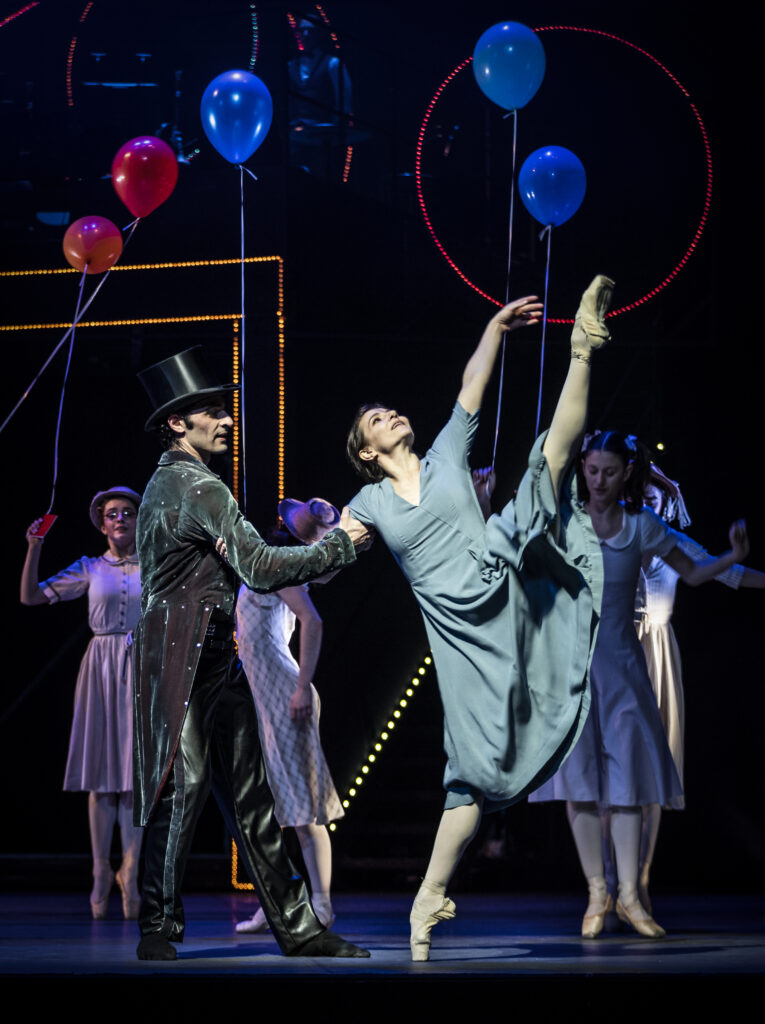
Jaiani believes approaching vulnerable emotions such as those she encounters as Julie requires communication and trust among the entire artistic team. She says Joffrey creates a safe environment in which to ask questions and explore emotions which bubble up in rehearsal: “Quite often we end our rehearsals by talking about the scene, thinking about nuances we have discovered—how far some of the steps took us emotionally.”
For Jaiani, navigating the volatile relationship between Liliom and Julie with dance partner Castro Cuevas first comes down to knowing the choreography inside and out, as well as fully exploring not only their own characters, but each other’s. Both physical and emotional preparation, she says, “is a good foundation to have, and that is how trust is built.”
At the end of each scene, Jaiani says she and Castro Cuevas take a moment to exit their characters and lend support to each other. As difficult as it can be, Jaiani says it’s her duty as an artist to tell real, human stories in a respectful and meaningful way.
“What we do onstage is connected to real people and real experiences,” she says. “Treating these stories with sensitivity—it makes my work more meaningful. That’s one way a dancer can connect to an audience member without knowing it.”