What Did Petipa’s Original Choreography for The Sleeping Beauty’s Aurora Look Like?

Many versions of The Sleeping Beauty are performed by companies all over the world. While each of these has its own artistic value, their source is nearly always Marius Petipa’s original choreography, made for the St. Petersburg Imperial Ballet in 1890. As a dance historian, I’m constantly searching for that source, that first version, and with The Sleeping Beauty we can get pretty close.
Using the ballet’s original libretto, together with notes made by Nikolai Sergeyev, one of Petipa’s rehearsal directors, we can learn about the story and steps of that first Sleeping Beauty and discover more about Petipa as a choreographer and creative artist. Sergeyev’s notes, which are preserved at Harvard University, document Petipa’s choreography, mime, and stage action based on rehearsals and performances in the first years of the 20th century, right around the time Petipa retired. They are key to The Sleeping Beauty’s importance in the classical ballet repertory: Sergeyev used his notes to rehearse the ballet at St. Petersburg’s Mariinsky Theatre and later to stage it for the Ballets Russes and The Royal Ballet (when it was still called the Vic-Wells Ballet).
With so many versions of his ballets onstage today, it’s easy to think of Petipa more as representing an ever-changing school of classical ballet technique and aesthetics rather than an individual choreographer who worked in the studio with the dancers of his company. But that’s exactly what Petipa did. He planned, experimented, and adapted his choreography based on the abilities of the artists in front of him. Sergeyev’s notes show us how Petipa put combinations together and what features of dance were important to him. In the case of The Sleeping Beauty, the notes allow us to peel away decades of changes made to Petipa’s choreography and bring us closer to what he first created.
The Role of Aurora
The Sleeping Beauty’s leading role of Princess Aurora is considered the epitome of classical technique and refinement. It’s also part of a lineage of 19th-century characters who were lively and outgoing and drove the ballet’s action. Petipa’s Aurora is 20 years old when we first meet her, not 16 (a change made for the 1921 Ballets Russes production). Instead of a teenager, Aurora is a young adult, empowered by the loving upbringing of her family and the gifts given to her by her magical godmothers in the ballet’s prologue. As she is introduced to her four suitors at the beginning of the Rose Adagio, Aurora’s father, the king, makes clear that her choice of a marriage partner is her own. All of Aurora’s choreography in the demanding first act is confident and assured. Later, during the ballet’s vision scene, she actively draws Prince Désiré to her. Then finally, at her wedding, Aurora tells everyone of her love for him during their pas de deux.
Both the libretto and Sergeyev’s notes make it clear that Petipa’s Aurora isn’t a passive heroine. Instead, she’s active, exhilarating, and the center of our attention. Like Giselle, Paquita, Swanilda, and a host of other ballerina roles, Aurora drives the action and the narrative in The Sleeping Beauty. She overwhelms the stage with energy from her very first entrance and takes charge of her destiny.
Petipa’s Choreography for Aurora
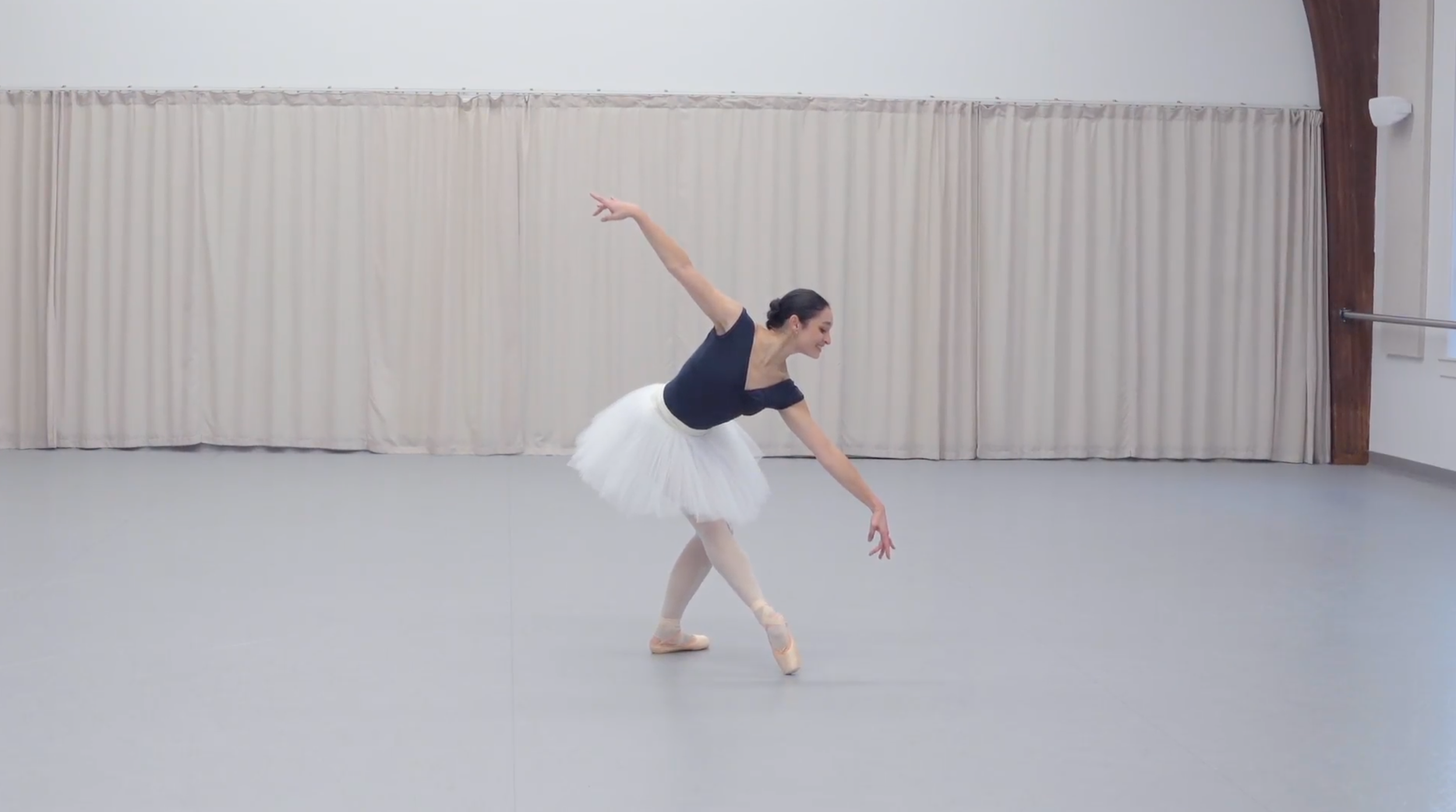
The excerpts in the videos below, danced by Pacific Northwest Ballet’s Malena Ani, have been staged based on Sergeyev’s notes. These dances for Aurora showcase important features of Petipa’s choreography; many of these elements he learned from his French predecessors. They include speed, combinations that really travel, a balanced and geometrical use of stage space, and a musicality that closely follows the rhythm. You’ll see that instead of moving flatly from side to side and directly facing the audience, Ani travels on the diagonal and is often oriented at a slight angle, which was thought to offer the most advantageous view of a dancer—like a sculpture moving three-dimensionally through space. Most combinations are performed three or more times (think “rule of threes,” a principle that suggests things presented in threes are more satisfying, memorable, and effective).
Lastly, the excerpts include unusual ways of performing common steps, including pas de chat and saut de basque. I always encourage dancers to keep an open mind when encountering Petipa’s choreography to see what we can learn from it.
Video No. 1: Aurora’s Act I Entrance With Traditional (Cecchetti) Pas de Chat
Petipa took care to make Aurora’s entrance breathless and thrilling. Her appearance should be more exciting than anything we’ve yet seen in the ballet. Aurora’s first petit allégro combination zigzags quickly downstage. I like to think that she’s greeting the crowds who have come to celebrate her birthday. She paddles back upstage and performs a second combination that has more sweep and grandeur: pas de chat, rond de jambe, relevé développé en tournant, and two emboîtés derrière.
Finally, she travels across the front of the stage toward her parents with a series of jetés separated by pas de bourrée. (If any step in The Sleeping Beauty can be called a signature step for Aurora, it’s this jeté/pas de bourrée combination: She performs it here, at the end of her Act I variation, and when she first appears in the Act II vision scene.) According to the notations, she finishes her entrance with chaînés on demi-pointe. For greater speed, Ani performs the chaînés on pointe.
Aurora performs pas de chat 10 times during her entrance. In this first video, Ani performs a traditional (Cecchetti) pas de chat.
Video No. 2: Aurora’s Act I Entrance Excerpt With Notated Pas de Chat
This time, Ani performs pas de chat the way it is notated by Sergeyev in his Sleeping Beauty notes, which you’ll see is different from a traditional pas de chat. (Alexei Ratmansky included this pas de chat in his recent staging of Paquita for New York City Ballet.) The ballerina Nadine Nicolaeva-Legat describes this step, calling it a grand pas de chat, in her 1947 book, Ballet Education. It’s similar to Gail Grant’s description of a grand jeté pas de chat in her book, Technical Manual and Dictionary of Classical Ballet.
Video #3: Aurora’s Act III Coda Entrance
A coda is traditionally filled with exciting steps and high energy. Aurora’s coda entrance in Act III not only showcases speed but also demonstrates Petipa’s musicality. He has given each note of Tchaikovsky’s melody a step, including three piqués, a jeté, and a pas de bourrée (notice how Ani’s raised foot is in front for the first piqué, in back for the second piqué, and in front again for the third). Aurora literally dances the rhythm of the melody! The jeté has a beautiful upward focus, which we took from a 1963 performance by Margot Fonteyn, who was taught the role by Sergeyev in 1939.
After performing this combination four times as she zigzags downstage, Aurora travels upstage to meet Prince Désiré as she performs a series of sauts de basque and piqué turns. The sauts de basque are different from the way the step is usually danced today—the ballerina Tamara Karsavina describes this version in her 1962 book, Classical Ballet: The Flow of Movement. After the battement, the leading leg is brought into coupé front before landing, creating a corkscrew effect with the feet.