Loughlan Prior’s Cinderella, for Ballet Ireland, Is a Magical Immigration Tale

Choreographer Loughlan Prior has a penchant for reimagining fairy tales. In his queered Cinderella (2022) for Royal New Zealand Ballet, Prince Charming gets the guy. Now, three years later, Prior is tackling the story again, for Ballet Ireland. Opening in Belfast November 7–8, Prior’s new Cinderella will run through December as the company tours to 13 cities throughout Northern Ireland and the Republic of Ireland.
Prior opted to set this version in 1950s New York City for a more modern feel, with the protagonist, Ellie, as a young Irish immigrant. When Ellie arrives in New York City, she gets a job as a maid at the Plaza Hotel under a nagging boss, Mr. Whitmore. Ellie is also pestered by two spoiled socialite sisters, Gertrude and Winifred, so when the hotel’s owners host a ball, Ellie wishes on a star to attend. With the help of her Fairy Godmother, Ellie attends the party and falls in love with the owners’ son, Alexander—until the stroke of midnight finds her dashing back to the basement laundry room. In the end, she’s reunited with both Alexander and her family.

Ballet Ireland artistic director Anne Maher approached Prior about creating Cinderella in spring 2024. Prior chose to choreograph to the original Prokofiev score, which he hadn’t used at RNZB, and to frame the ballet as an immigration narrative. “It felt very much like the beginning of Cinderella’s story, where she’s alone, in a new place,” he says. And Ellie is no wallflower—Prior describes her as “feisty.”
Dancer Ashley Tsuyu Burks has enjoyed working on Ellie, her first lead role as a professional. Given the familiar story and music, she says, diving into the character has felt natural despite differences in Ellie’s personality: “The underlying story remains the same.” So far, her favorite part of the process has been developing her acting.
Prior strove to make the characters’ relationships realistic. Long before the party, Ellie and Alexander meet in a moment of “kismet” on the street. “To me, that’s much more romantic and real than this manufactured fairy-tale meeting,” says Prior. “They’re kindred spirits, even though they’re wildly different in class.”

For Ramon Pascoli, who is performing as Alexander, the biggest challenge has been making his movements more “human,” he says: “Loughlan said to have an actual dialogue in our minds—‘Do you want to hold my hand?’—so it looks like more of a conversation than steps.”
Prior has combined classical ballet with more theatrical movement, depending on the character. Gertrude and Winifred, for example, have a slapstick, cabaret style, while Mr. Whitmore is “dexterous and sinuous.” (Prior chose to replace the usual Evil Stepmother character with Mr. Whitmore to give male dancers the opportunity for another substantial role.) There’s also plenty of humor—when the Fairy Godmother arrives, she emerges from a washing machine.
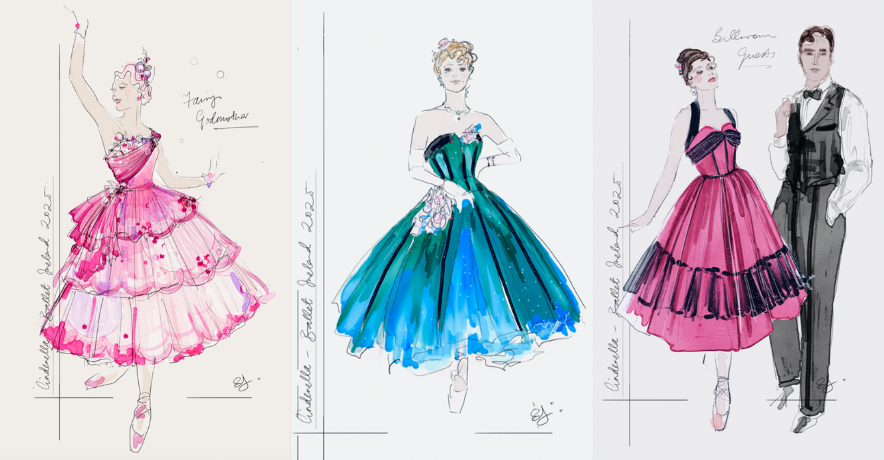
To capture the 1950s essence, sets and costume designer Elin Steele created a transformable backdrop with a black-and-white newspaper theme. At select moments, lighting by Bonnie Beecher will add additional pops of color, and scenic projections will provide a more “immersive” effect, Prior explains.
Both Tsuyu Burks and Pascoli believe that audiences will enjoy the ballet’s familiar story and rich visual elements. “Most ballets don’t cover immigration,” adds Pascoli, explaining that he appreciates having a full-length dedicated to the Irish expat experience. He also finds the ballet as a whole widely relatable: “There’s something everyone can relate to.”
Prior agrees, and is glad that the dancers get to tour the production across the country. To him, the ballet’s reflections on modern power dynamics is timely, and its core message is evergreen. “Cinderella is all about kindness, respect, goodliness—virtues that have stood the test of time.”