Dance Theatre of Harlem Revives Its Signature Firebird

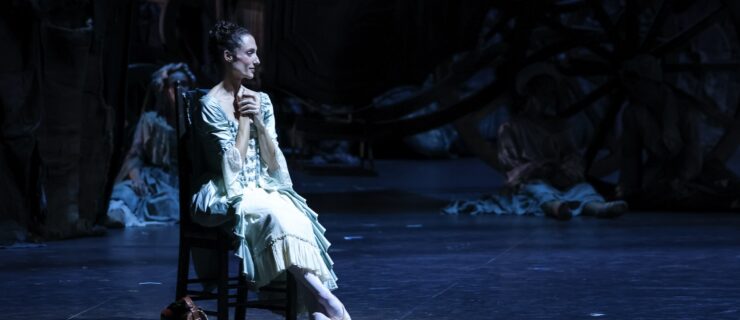
As Igor Stravinsky’s Firebird music spiraled to a high pitch, Dance Theatre of Harlem’s Alexandra Hutchinson rushed onstage from the wings, head lowered and arms pressed behind her. Framed by scrims of large tropical flowers, she launched into a powerful solo, with pricking piqués, fluttering hands, and sharp, darting eyes. Later, a procession of spectacularly costumed dancers filled the stage at The Performing Arts Center at Purchase College, where DTH was holding a sneak-preview performance last week. As they formed a grand tableau, Hutchinson rose above them in flight. It marked a triumphant moment not just in the ballet, but for the company itself.
DTH last performed John Taras’ Firebird in 2004, right before the company went on a six-year hiatus. When the ballet premiered in 1982, New York Times dance critic Anna Kisselgoff hailed it as an “instant hit” that sends “its audience into a whooping spell of delirium.” Set in an enchanted garden, and featuring lush designs by Geoffrey Holder, Firebird would become one of DTH’s signature pieces, toured widely around the world. However, the company has not had a roster large enough to perform it since regrouping in 2010.

Now, Firebird is making a comeback, thanks in part to a partnership between DTH and the University of North Carolina School of the Arts. The company will debut its refreshed production November 15–16 in Detroit, Michigan, and later tour to Paris and Norfolk, Virginia, before DTH’s annual New York City Center season.
“When we first joined the company, we’d hear whispers about wanting Firebird to come back,” says dancer Derek Brockington, who joined DTH in 2018 and will dance the role of the Young Man. “This is something we’ve held on to and looked forward to.”
Firebird’s History
Artistic director Robert Garland says that remounting Firebird is deeply important for DTH, and helps connect its historical repertoire with current audiences. For the company’s late co-founder, former New York City Ballet principal Arthur Mitchell, Stravinsky’s Firebird spoke to both his Balanchine lineage (Mitchell had worked with the composer during the 1957 creation of Agon) and his admiration for the Ballets Russes, where Michel Fokine first choreographed the work in 1910. “Mr. Mitchell saw DTH as a bridge between those two camps,” Garland says, noting that the company’s co-founder, Karel Shook, and its longtime artistic advisor Frederic Franklin, both danced with Ballet Russe de Monte Carlo. George Balanchine, who had had great success with his own Firebird at NYCB, encouraged Mitchell to produce an original version for DTH, and lent NYCB rehearsal director John Taras to choreograph it.
The ballet, originally a Russian folk tale, was moved to a Caribbean setting. Mitchell commissioned Trinidadian dancer, actor, and artist Geoffrey Holder to design the costume and the sets. Holder’s backdrops featured large, painted orchids, vines, and passion flowers, while his brightly colored costumes took inspiration from a myriad of cultures. “DTH’s version takes the original story and allows it to be told from another perspective,” says Brockington. “I think there’s a lot of power in that.”
The ballet made stars of Stephanie Dabney and Donald Williams, the original Firebird and Young Man, who led the company in a national PBS broadcast in 1982. “Everyone who worked with Stephanie tells us how she really turned into her character,” says Hutchinson, who has been watching videos of Dabney’s performances to prepare. “My parents both saw Firebird back in the ’80s and would tell me about it all the time growing up. I’ve wanted to do this role my whole life.”

Bringing Back a Classic
The revival has been three years in the making. Endalyn Outlaw, dean of UNCSA’s School of Dance, first had the idea after School of Music dean Saxton Rose suggested they collaborate using a Stravinsky score. Outlaw, a former DTH principal who later served as Dance Theatre of Harlem School’s director, immediately thought of Firebird. “It was a rite of passage for the dancers and a huge part of our rep,” she says. “I saw a natural opportunity.”
She, alongside Kevin Bitterman, executive director of the Thomas S. Kenan Institute of the Arts in Winston-Salem (which provided funding and programming support), approached Garland and DTH executive director Anna Glass about producing a workshop version for UNCSA. This sparked further conversations. In 2023, the two organizations announced an official partnership, with plans for staging a student performance at UNCSA in 2024 and a full company production in 2025–26. Last year, Donald Williams and former DTH principal Charmaine Hunter staged the ballet on UNCSA’s dancers in both New York City and on campus in Winston-Salem. Hutchinson and Brockington joined the rehearsals and starred in UNCSA’s opening-night principal cast.
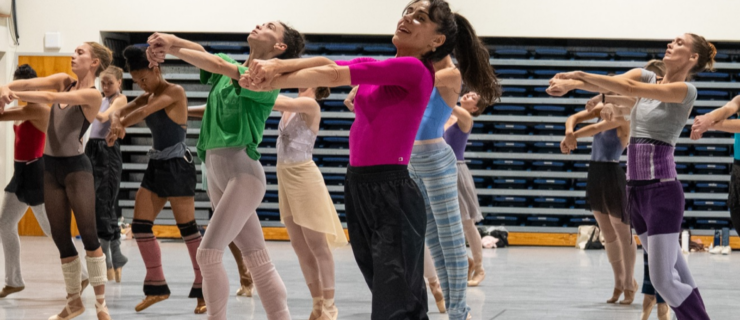
For DTH’s upcoming tour, 32 university students, split into two casts, will supplement the corps de ballet in the roles of Beautiful Maidens and Creatures of Evil. “Those dancers will have an opportunity that is unlike any other, getting real company experience,” says Garland, who has also added eight guest artists to DTH’s roster.
Former DTH dancers Iyun Ashani Harrison and Naimah Kisoki staged the ballet on UNCSA’s dancers in Winston-Salem while the company rehearsed in Harlem. The students then flew to New York City in early November so that the full cast could rehearse together and have its preview performance at The Performing Arts Center at Purchase College before the Detroit premiere. The UNCSA Symphony Orchestra recorded the score for the tour, and 10 student musicians will perform with the Virginia Symphony Orchestra for the Norfolk performances. Meanwhile, Holder’s son, Leo Holder, has helped oversee the reconstruction of his father’s designs.
For Garland, those designs are part of what makes DTH’s Firebird production so remarkable. “You have to be careful with things that have been done before, because sometimes they don’t stand the test of time,” says Garland. “But I think this one will.”