How Ballet Exercises in the Water Can Benefit Your Technique

It’s a well-known fact that adding swimming to your cross-training routine can offer many benefits: increased lung capacity, core strength, and cardiovascular endurance, to name a few. But what about performing ballet exercises in the pool?
Besides being loads of fun (who can resist an underwater grand rond de jambe?), training in the pool can increase strength and mobility, aid with correct muscle activation, offer rehabilitation for various injuries, and much more.
Here’s why water workouts are so effective, and how to add ballet technique to your pool time this summer.
Strength Training
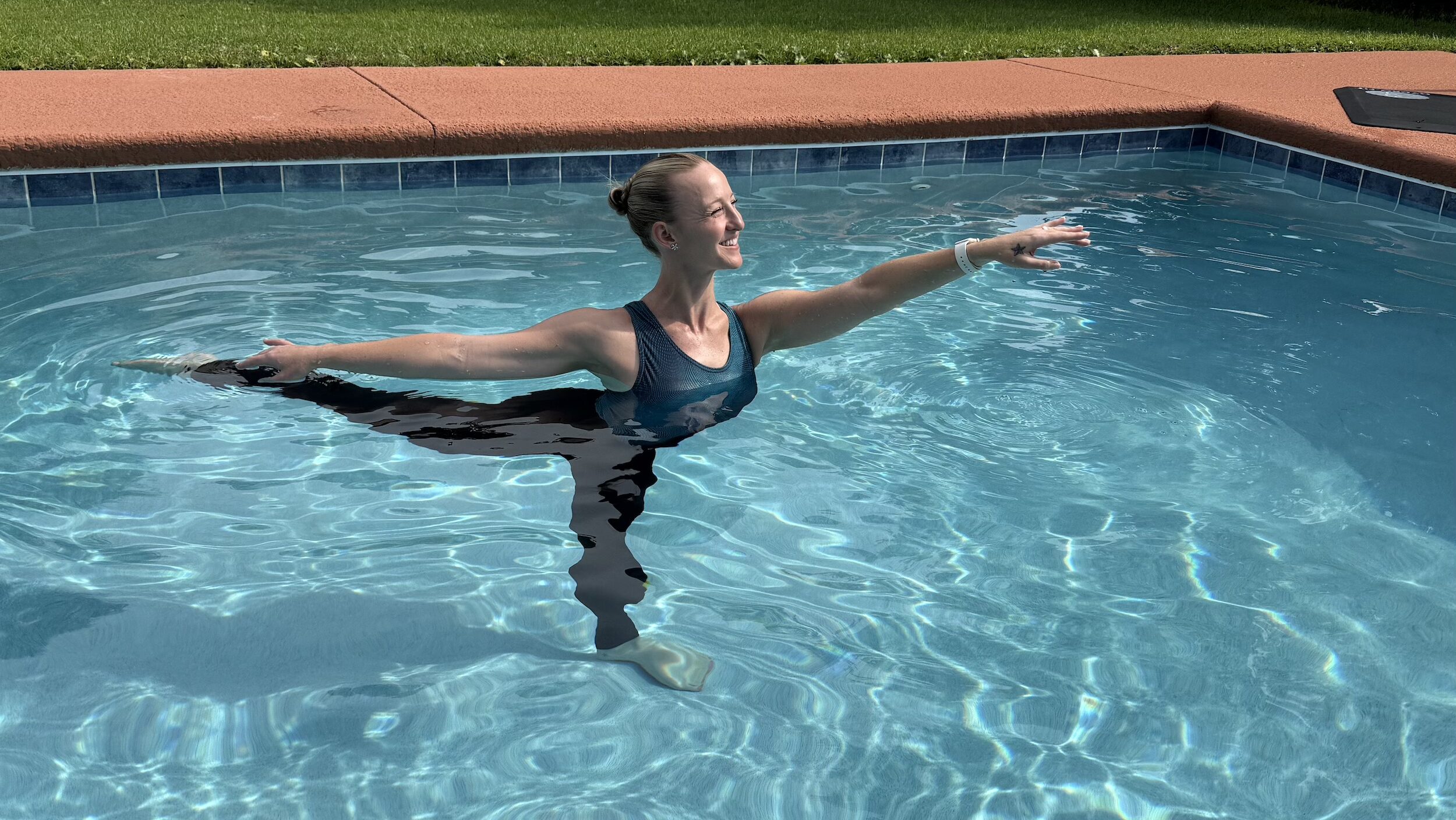
Movements like a développé à la seconde may feel“weightless” because of water’s buoyancy. But Ashley Bishop, an aquatic training specialist for the Aquatic Exercise Association, challenges the idea that ballet combinations in the pool areeasier. “It’s a 360-degree workout,” Bishop says, explaining how water’s viscosity provides resistance for every movement pathway, leading to concentric muscle contractions when lifting and lowering your leg.
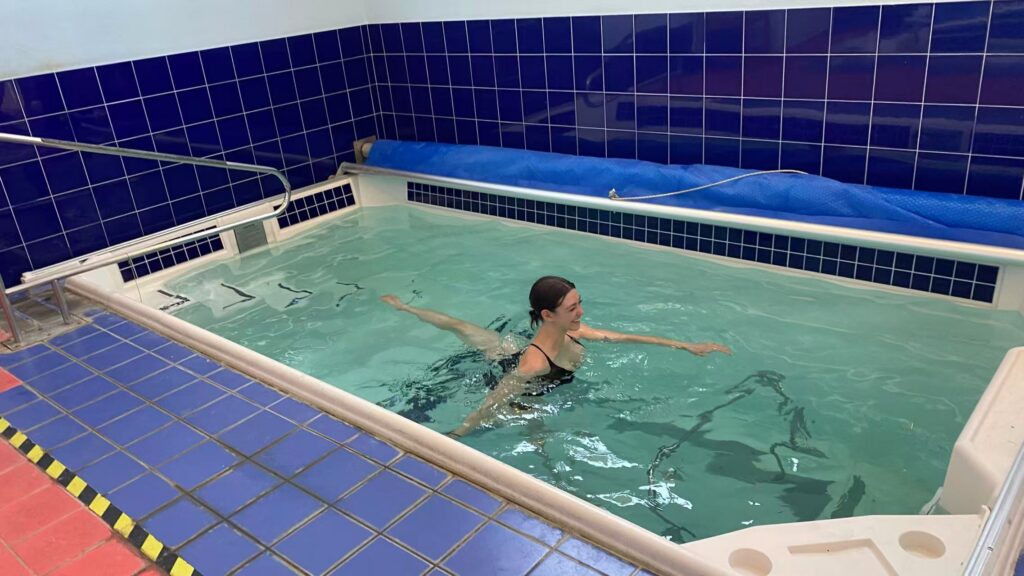
Kristen Davis, PT, DPT, a senior physical therapist at Boston Sports Medicine who specializes in aquatic therapy for dancers, says water provides 12 to 14 times more resistance than air. The multidimensional resistance “builds strength and endurance while reducing impact,” she says. Plus, the slow-motion effect that water createshelps increase control.
Use that resistance and lifted feeling to focus on posture and alignment in extended positions. “You can really feel your potential range of turnout and mobility without having to fight those external forces,” says Bishop, who incorporates ballet aquatic workouts into her dance and fitness classes. Accessing greater turnout and external rotator connection underwater will translate to your work in the studio, she says.
Rehabilitation
Boston Sports Medicine often uses aquatic therapy to treat dancers from Boston Ballet and Boston Conservatory for orthopedic and stress-related injuries, especially when weight-bearing is limited.
“If a dancer is unable to perform a relevé due to weight-bearing restrictions on land, we can begin working in that position sooner in water,” says Tiffany Wong, CPT, a dance rehabilitation specialist at Boston Sports Medicine. The water’s buoyancy lowers stress on the joints and can reduce pain and inflammation, adds Davis.
Water also offers a low-impact transition before jumpingfull-out in the studio. Bishop recommends combinations with sautés, échappés, and jetés for calf and ankle strengthening in the pool. Both she and Boston Sports Medicine staff will use water temperatures between 88 and 90 degrees Fahrenheit to improve circulation and muscle relaxation.
Getting Started
“Anything that we can perform in the dance studio can be replicated in the water,” says Wong, including across-the-floor exercises. Practice simple barre exercises at first; hold movements that may typically be hard to control in class, such as a battement derrière, to check for correct alignment and muscle activation.
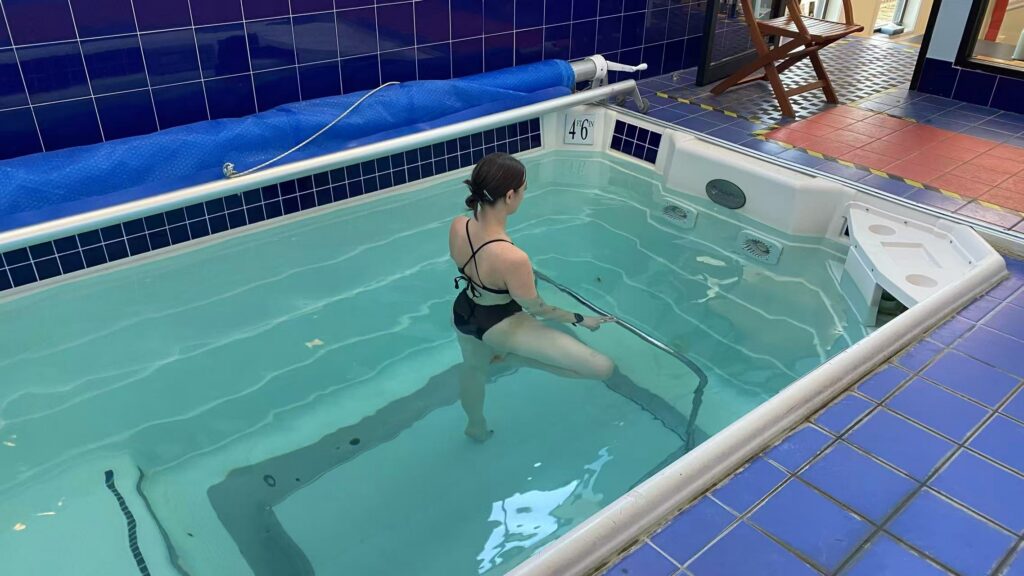
Don’t hold back—try simple port de bras for back engagement, a slow-motion grand jeté for one-foot landings, or piqué turns to challenge your balance.
Try This: Water Développé à la Seconde
Kristin Davis shares a step-by-step exercise using water resistance to build strength and control in développé à la seconde.
- Face the wall or pool edge in chest-deep water. Stand tall with an engaged core, neutral pelvis, and long posture. One hand may lightly hold the wall for balance if needed.
- Bring the working leg to retiré and slowly développé to second position, reaching through the foot.
- Hold for 2–3 seconds. Keep hips square, core engaged, and the supporting leg strong.
- Slowly return the leg to retiré with control. Avoid letting the leg drop.
- Perform 8–12 repetitions from retiré to extension before lowering the leg. Complete two to three sets on one side, then repeat on the other.
Pro tip: Move slowly and with intention while keeping the torso lifted and shoulders down. Using the water’s resistance, exhale on the lift and inhale on the return.