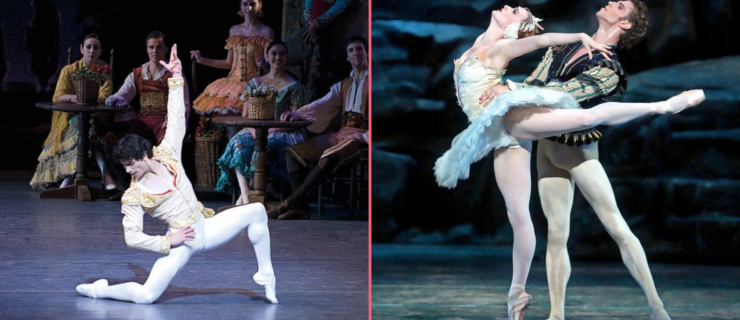
Danbi Kim on How Houston Ballet’s Updated Raymonda Centers Romance and Sisterhood

Last spring, Houston Ballet soloist Danbi Kim walked into a routine fitting and was surprised to see an ornate gold tutu from Raymonda hanging from the rack. She was even more surprised when the costumer asked her to try it on; at the time, the company was performing Cinderella, and artistic director Stanton Welch’s world premiere Raymonda wouldn’t debut for another year.
“I thought, I’m an average size here. Maybe they just want to see the costume on someone,” says Kim. But flash forward to September, and Kim found herself walking to the center of the studio—cast as Raymonda. It would be the first time she’d open a production as a first-cast principal. “Internally, I was turning red,” she says. “I couldn’t believe it.”
Welch’s new Raymonda, running May 29–June 8 at Houston’s Brown Theater, includes updates to the original libretto while maintaining the ballet’s classicism and style, with few changes to the classical choreography. Not only has he introduced six new sisters for Raymonda, but he has also removed the offensive narrative surrounding the villain Abderakhman and erased any specific references to the Crusades. Instead, an evil plot by the queen’s advisor becomes the ballet’s main conflict, with a subplot of Raymonda and her sisters navigating arranged betrothals.
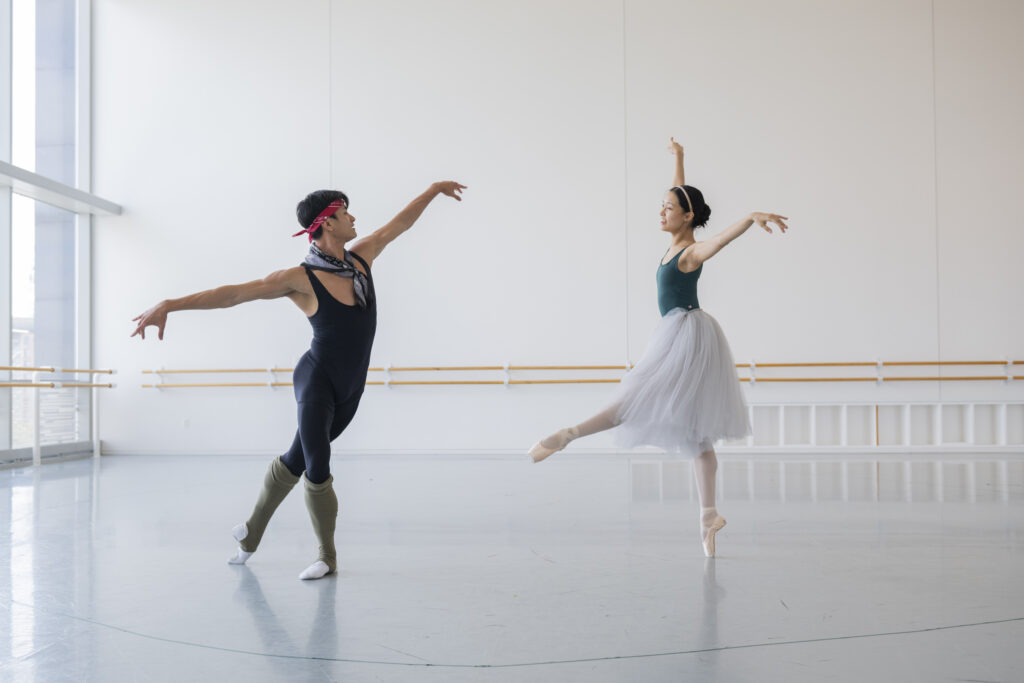
“People don’t really do the full Raymonda anymore. Only the third act,” says Kim, who performed that exact excerpt in a spring showcase as a member of Houston Ballet II. “That was here in this building, the Houston Ballet studios. It’s quite special to revisit.”
Kim will dance the title role on opening night alongside guest artist Chun Wai Chan, a current New York City Ballet principal and former Houston Ballet star, who will perform the role of Raymonda’s love interest, Jean de Brienne. She and Chan rehearsed together for two weeks in October and one week in March, but since then she’s been practicing with fellow company dancers Eric Best, Naazir Muhammad, and Angelo Greco until Chan can return—two days before opening night.
“I was honestly scared and worried about it,” says Kim, “but he’s a great partner, and if Stanton has that much trust in us, I’m going to have to trust myself as well.” (Prior to Raymonda, Kim had never partnered with Chan—she was still in the Houston Ballet corps while he was a principal there.)

For Kim, Welch’s pas de deux choreography has been one of the most technically difficult parts of his new Raymonda. But artistically speaking, bringing authenticity to her character has been even trickier. To start, Kim has tried fusing elements of her own personality with Raymonda’s, focusing on the young countess’ pluckiness, dreaminess, and emotionality. (“How would I react?”) But in a larger sense, she’s trying to connect the contrast between the ballet’s first two acts with the third through her acting:
“In the first and second act, the way I approach certain positions can be more natural and relaxed. I can be more human,” she says. Kim also explains that her costume for Acts I and II, a Romantic tutu with a slightly loose hairstyle, acts almost as an extension of her movement style. It’s a noticeable difference with what she wears in the third act: a tight bun, a tiara, and the gold classical tutu. The Act III choreography also references the original character-dance flair and is much more formal. “During one Act III rehearsal I realized I was too focused on the dancing and had stopped looking at my partner like a lover,” she says. “I thought, I can’t be doing this! We still need to have that love connection, because that’s how we got here.”

But when it comes to the new addition of sisterhood, the acting has felt second nature to Kim, who, despite being an only child, sees her fellow company members as family.
“We take care of each other,” she says. “You can probably feel that watching the ballet. Our reactions are genuine, and each of our personalities melds into our characters. That’s special, and very different from the original.”