Safe and Effective BOSU Ball Training for Dancers—Plus 3 Exercises to Try

On social media, it’s common to see dancers post workouts on BOSU balls, pieces of fitness equipment that look like half of a stability ball. Depending on the exercise, either the flat side or the inflated dome on the other side can face down, and the videos often show dancers practicing impressive penchés or adagio.
While working out on a BOSU is certainly challenging and can look cool, it’s important to understand how to use it safely and effectively to maximize the benefits for ballet. Read on for some best practices, plus three exercises to try, courtesy of Proteus Fitness founder Alex Gonzaga, a former dancer with Atlanta Ballet and Terminus Modern Ballet Theatre.
How the BOSU Helps
According to Gonzaga, BOSUs help build strength and stability in the muscles closest to the center of the body, like the core and glutes, so more distant body parts, like the ankles, can stay relaxed and reactive—not stiff. This is known as proximal stability allowing distal mobility, says Gonzaga: “It’s the same idea as someone gripping their ankles as opposed to releasing into a plié.”
The BOSU helps develop proprioception, especially the mind–muscle connection between the ankles, core, and glutes. That makes it excellent for ankle-sprain prevention and rehabilitation, as well as practicing safe landings by encouraging ankle reactivity. “If you land a jump slightly off-center, and there is a little inversion or eversion, your ankle should be able to respond quickly and bring you to a safe landing,” says Gonzaga.
When standing on one leg, dancers often try to stabilize by incorrectly engaging the working leg’s hip flexor, Gonzaga explains. Single-leg exercises on the BOSU can strengthen the right muscles—again, like the core and glutes—for controlled fondus and adagio.
Exercising Safely on BOSUs
Despite what you see online, Gonzaga does not recommend practicing pointework or certain jumps on a BOSU. Proper pointe training requires a stable surface, but a BOSU ball is designed to “deform and yield under weight,” says Gonzaga. This forces the foot and ankle muscles into hyper-mobility under full body weight, which can fast-track injuries or cause dancers to compensate with the wrong muscles.
The BOSU also acts like a “sponge for kinetic energy,” says Gonzaga. So jumping from one limits the power you can exert compared to taking off from a flat, stable surface. “You lose that elastic recoil in the Achilles tendon and calf complex, translating to a heavier, less explosive takeoff,” he says. Jumping onto a BOSU can help strengthen stability and reactivity, especially for landings, but it should be done under supervision, with a clear goal in mind, and with proper technique to minimize injury risk. Additionally, it will not increase jump height, and it can throw off alignment in the knees and ankles upon impact, so be careful. “Jumping on a BOSU is best for dancers with a solid foundation of stability, strength, and landing mechanics and should ideally be done under the supervision of a physical therapist or certified trainer,” he adds.
And what about those impressive penchés on social media? Gonzaga says the danger in extreme movements on the BOSU is developing compensation patterns, such as gripping the hip flexors or losing neutral pelvic alignment while trying to stay upright. Using a BOSU is a progression, or an added challenge, after you have mastered the basic exercise on a stable, flat surface. So if a dancer wants to build up to adagio on the BOSU, Gonzaga suggests first identifying your training goals; there are likely less risky alternatives, like single-leg Romanian deadlifts and squats for single-leg stability, or hip thrusts and step-ups for stronger hips.
Three BOSU Exercises to Try
Below are three of Gonzaga’s favorite BOSU exercises, which can be done in bare feet, ballet slippers, socks, or athletic shoes, with the BOSU’s flat side facing up. He advises paying attention to your body while doing them, focusing on consistency over intensity. If you are struggling to feel the proper muscles, start standing on the floor before moving to the BOSU. Always stop if anything hurts.
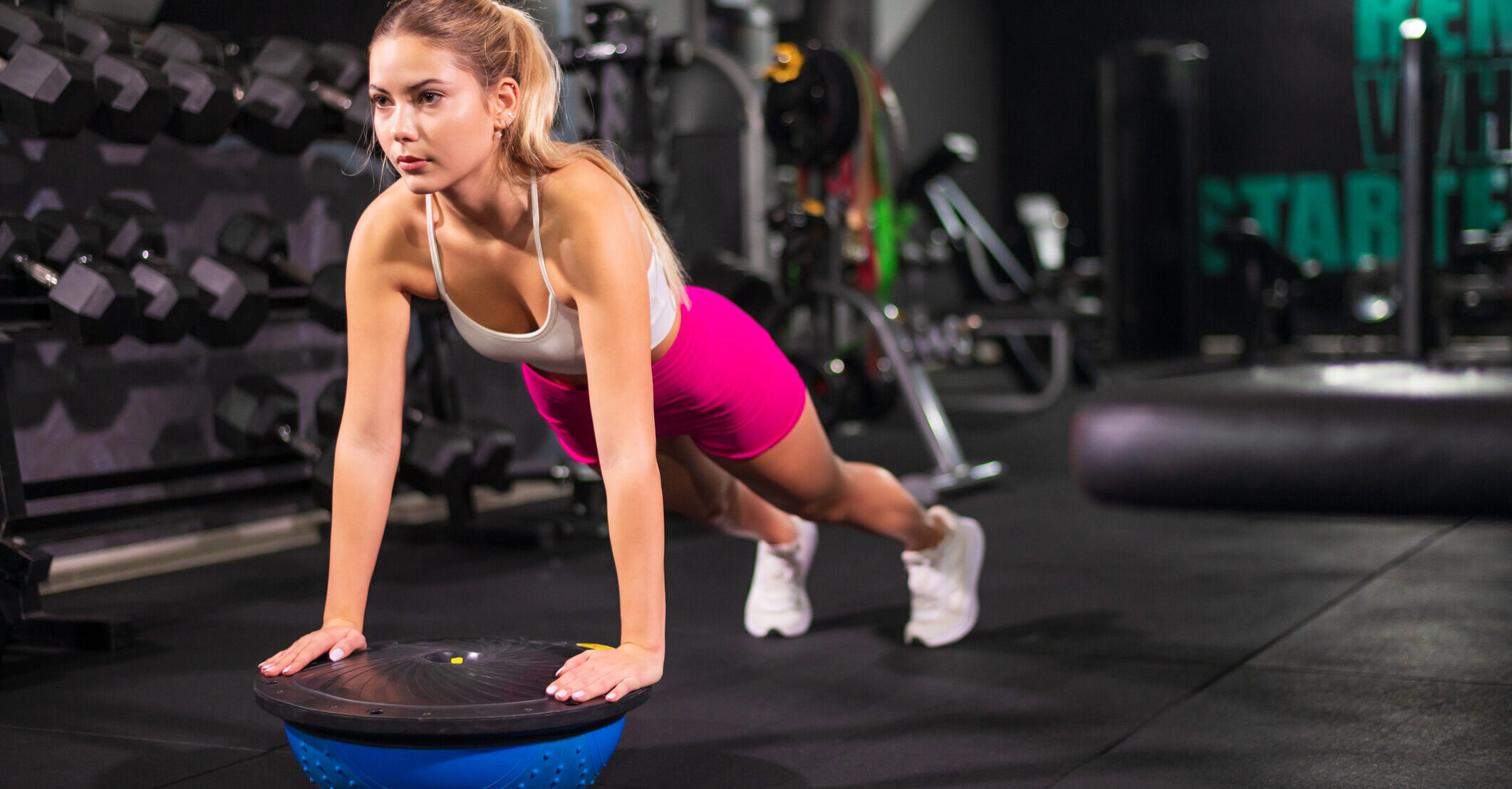
Exercise 1: Core plank
Building core strength helps with overall stability and coordination, allowing for better placement and range of motion while dancing. If you are a beginner, hold the plank for 30 seconds for 2 or 3 sets; if you are more experienced, try for 60–90 seconds per set. (Tip: Holding the feet together is more difficult than placing them further apart.)
- Go into a plank position with your hands on the BOSU, stacked underneath the shoulders, and your elbows straight. Feel the shoulder blades sliding down toward the hips and the abdominals activating. Resist rotating in the upper body.
- To level up, add a tennis ball and try to keep it on the BOSU. Keep the elbows straight to work the core, not the upper body.
Exercise 2: Single-leg stand
This exercise develops overall strength and stability, challenging dancers to maintain coordination without gripping the ankle. Hold for 30 seconds to 1 minute on each side; 1 or 2 sets per leg. (This can also be done in a turned-out position with the other leg held in a relaxed cou-de-pied. For an extra push, try it with your eyes closed.)
- Stand on one leg, parallel, in the middle of the BOSU. Focus on your deep core and supporting glute. Keep the standing ankle relaxed and reactive; wobbling is okay.
- Stand tall as you move your arms through port de bras. Keep your coordination throughout the body.
Exercise 3: Fondu back
Fondus on the BOSU can help dancers identify their supporting glute and core muscles to better control their extensions. Complete 5–8 reps per side for 1 or 2 sets per leg.
- Stand on the BOSU on one leg, turned out. Fondu in cou-de-pied derrière while keeping the standing ankle relaxed and reactive—no gripping. (Again, wobbling is okay.)
- Extend into a 45-degree arabesque, with the arms moving into first arabesque. Since the leg is low, you should not feel your lower back taking over. If you do, it means you are not engaging your working glute and hamstring to extend the leg.