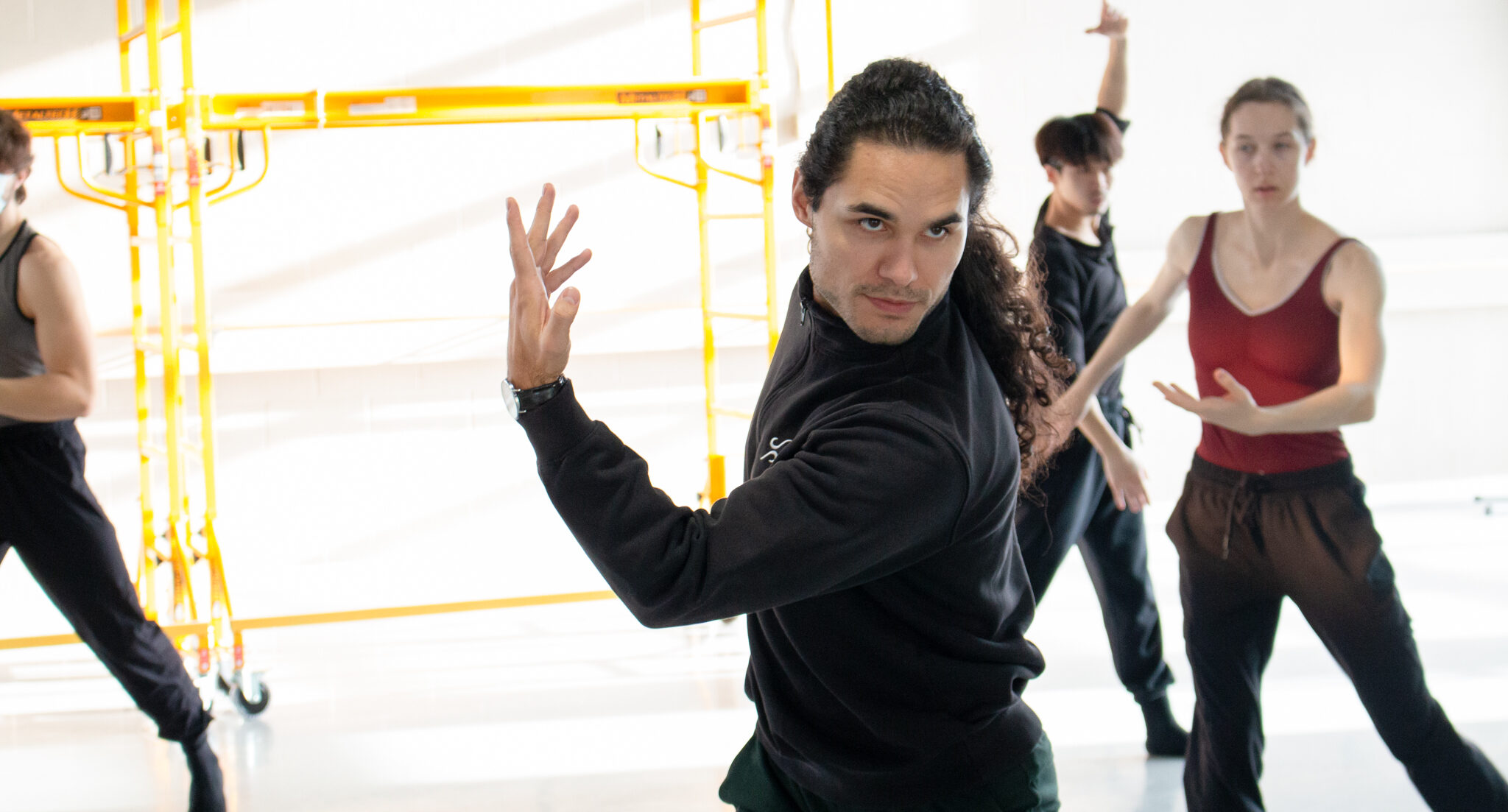
Choreographer Cameron sinkʷə Fraser-Monroe, of the Tla’amin First Nation, Takes Canada by Storm

Over one busy weekend at the beginning of May, Canadian choreographer Cameron sinkʷə Fraser-Monroe will premiere two new ballets in two different cities. From April 25–May 1, he’ll be traveling from Montreal, where he is Indigenous Artist in Residence at the National Theatre School of Canada, to his home province of British Columbia for opening night of Cikilaxʷm: Controlled Burn, his full-length for Ballet Kelowna centering climate crisis. The morning after, he’ll hop on a plane to Winnipeg to watch the Royal Winnipeg Ballet perform his šɛgatəm (pronounced shAY-ga-tum), which opens there on April 30. (An earlier version of the work, whose title is an Ayajuthem word that means “to lift someone up,” appeared at New York City Center’s Fall for Dance festival in 2024.) Then it’s right back to Montreal for the National Theatre School’s graduation showcase.
When an artist’s commitments stack up like this, you know their trajectory is heading in the right direction. A member of the Tla’amin Nation on the West Coast of Canada, Fraser-Monroe is comfortable with a wide range of dance forms—as a child, he studied Ukrainian dance, Indigenous hoop and grass dance, and classical ballet before moving to Winnipeg to study at the Royal Winnipeg Ballet School. “This mix reflects what my choreographic voice is now,” he tells Pointe. “It’s a braiding of the traditional, the classical, and the contemporary into something uniquely my own.”
As a professional, Fraser-Monroe danced with RWB, the Dancers of Damelahamid, and Atlantic Ballet Theatre of Canada. He also performed in dance festivals and worked in television and film. Still only 27, he’s now in demand as a choreographer.
Below, Fraser-Monroe speaks on his relationship to ballet and discusses his two back-to-back premieres.
What drove your decision to move at age 15 to study at the RWB School?
Ask any First Nations artist—ask any artist—you have to go to the city, the metropolitan areas, especially at the beginning of your career. I’ve always liked a challenge, and ballet was one of the hardest things I could find, so I followed that to Winnipeg. I wasn’t coming from a hugely wealthy background, and I knew that I needed to pay my bills. Ballet is one of the few artistic professions where you can be on salary and have health benefits, so that was really a pragmatic choice.
That said, my time at RWB was not without challenges. Up until very recently, I guess I had on rose-tinted glasses about how welcome I would be in a ballet space looking the way I do. But I think that we all struggle to a certain extent in the ballet environment. I’m not unique in that way. It’s certainly something I reflect on, especially since I continue to work in the place that I trained.
Have you seen any positive changes in ballet in terms of inclusivity?
I have seen some really incredible progress, specifically for Black dancers, through the advocacy of Theresa Ruth Howard and others, but I don’t see more Indigenous dancers being allowed into classical dance spaces. It’s disappointing.
How do you view the relationship between Indigenous art and ballet?
Indigenous art has the ability to make space for us to confront our biases and emotions and to really come together. For me, ballet can support that reach with the resources available to it. That has been my approach to using ballet as a technology, as a platform, to talk about the things I would like to talk about. I was really fortunate to come up watching Indigenous matriarchs like Santee Smith and Margaret Grenier creating works that could be shared widely—working with ballet companies allows us greater scale. And our stories deserve this opulent display because they are epic, exciting stories, and people need to see them.
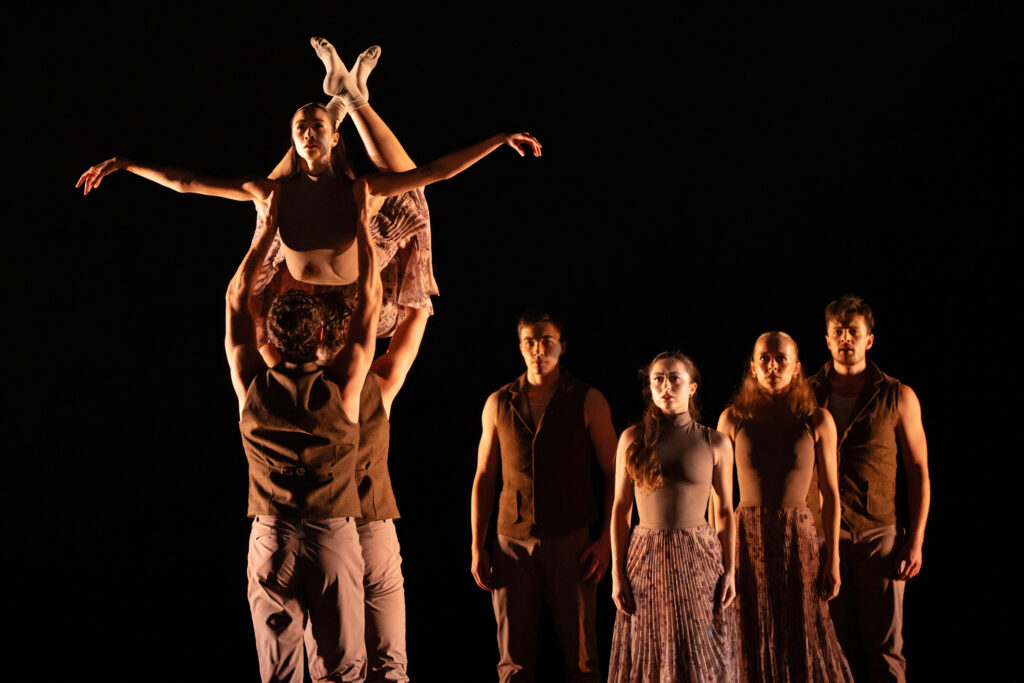
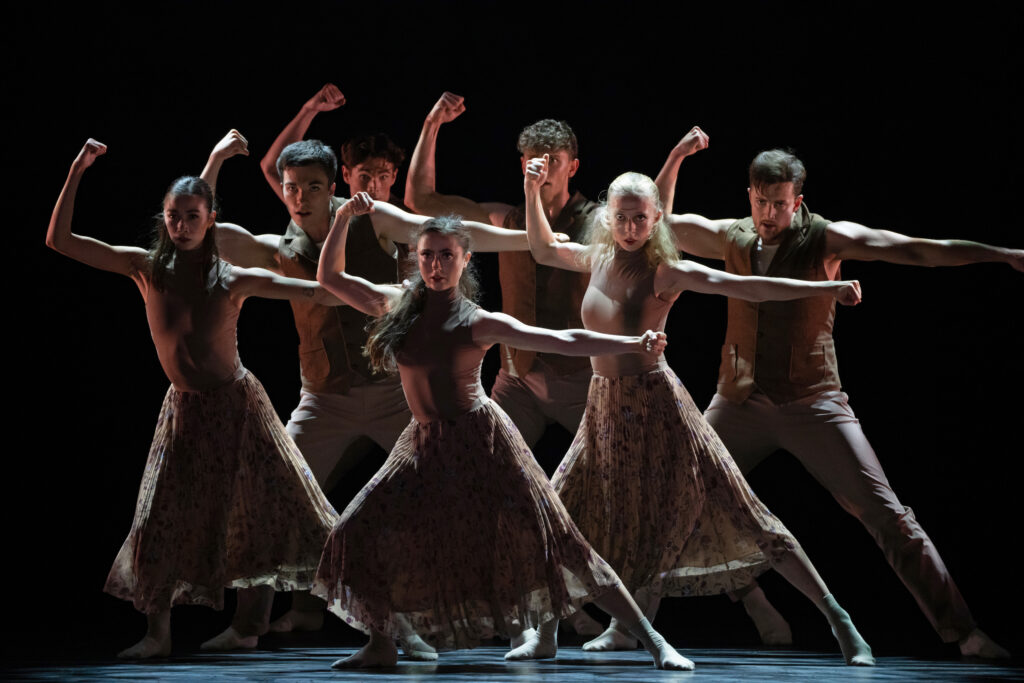
Let’s talk about šɛgatəm, which was a co-commission through RWB, Bard Center for Indigenous Studies, and New York City Center.
There are so many teachings from the Tla’amin Nation that I want to talk about; it’s all about finding the right container for them. Something that was on my mind was leadership. I was looking at leaders like my father, who’s a public health doctor that got burned out during the pandemic.
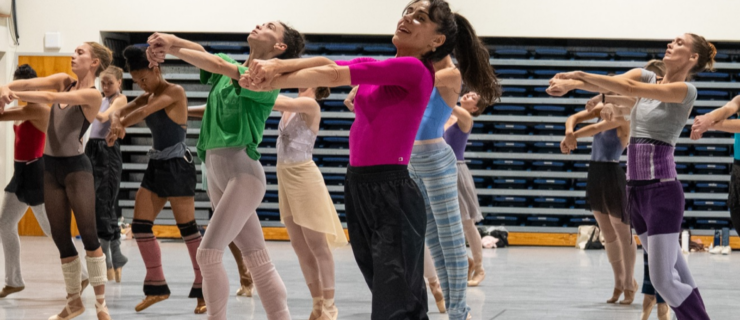
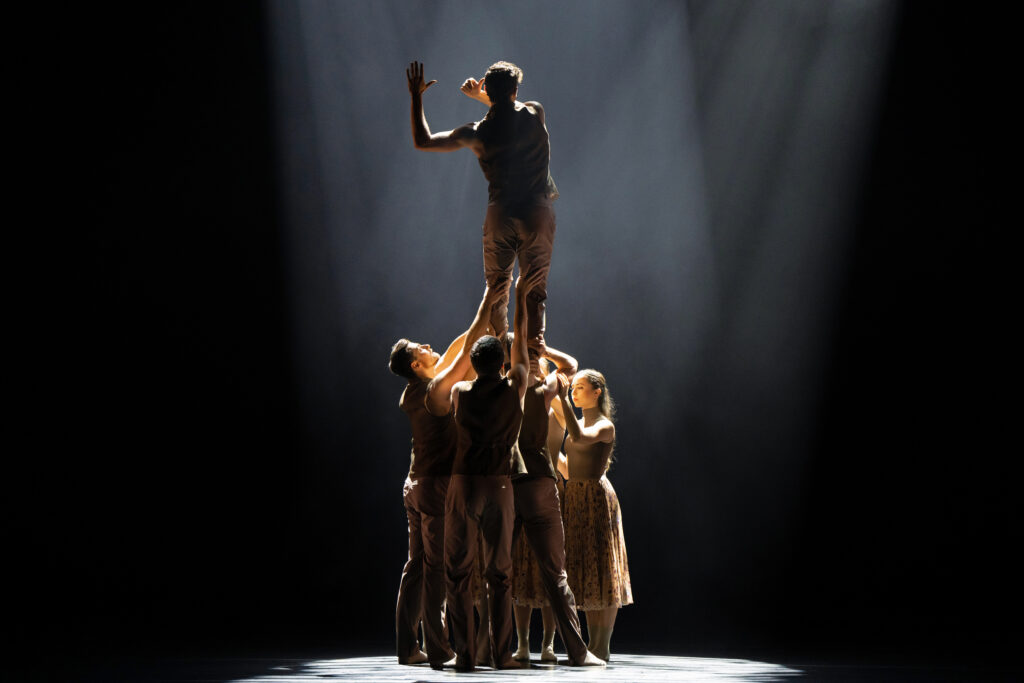
It’s important to ask how we can support our leaders, and how can our leaders ask for help so that the weight of the world is not crashing down on their shoulders. The idea is reflected in the opening of the work: a dancer standing on the shoulders of the ensemble and slowly falling off.
Composer and singer Jeremy Dutcher gave me musical inspiration for the work, as well. All of my commissions for ballet companies have featured Indigenous artists as composers and designers. Cree composer and cellist Cris Derksen scored Cikilaxʷm: Controlled Burn.
Speaking of, Cikilaxʷm: Controlled Burn sounds completely different, thematically.
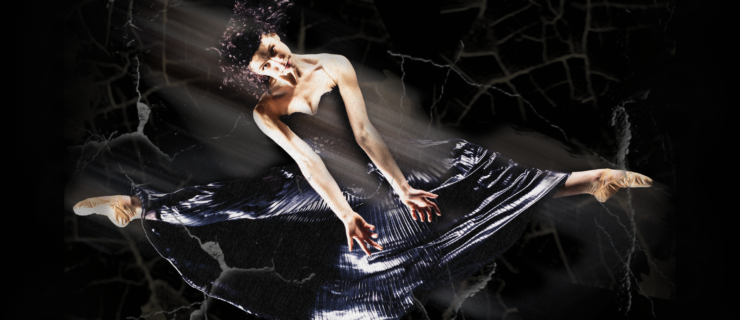
I know we have many pieces of art about the climate crisis, but there is actually a solution to this problem of wildfires: the Indigenous right to steward and the traditional practice of controlled burns.
I’ve created a world where fire burns year-round, which is very infernal but perhaps not far in our future. The characters within that world are coping with this dystopian reality in different ways. The central character is Nathan, a young Indigenous firefighter, performed by a Métis Ballet Kelowna dancer, MacKye White. He’s torn between two approaches to dealing with this emergency—one with the Indigenous knowledge keepers and the other with his boss, the fire chief.
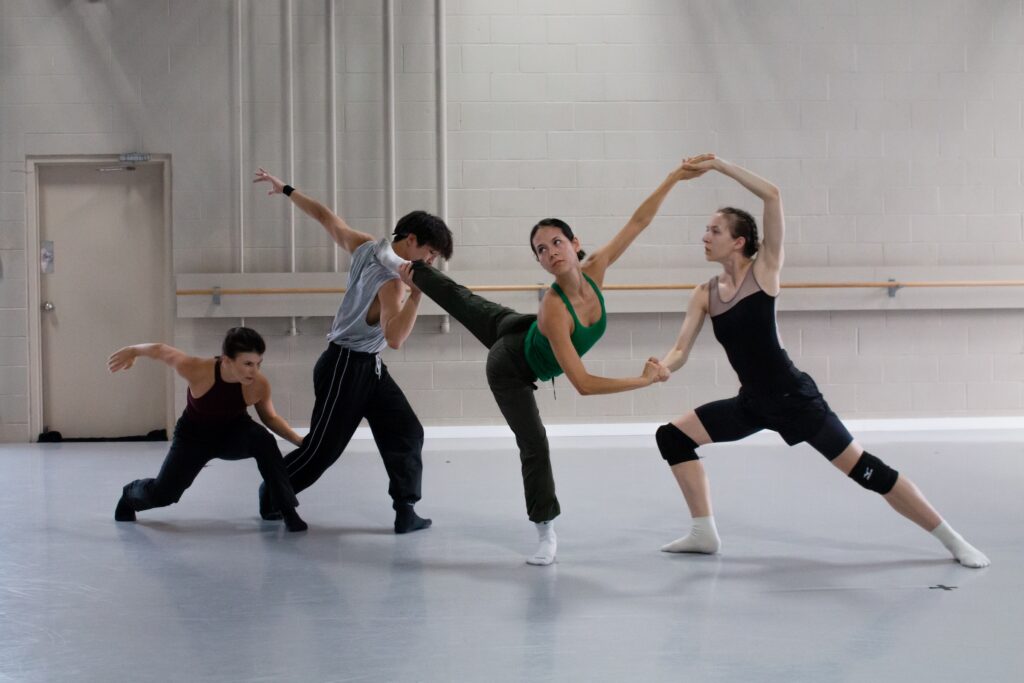
There’s a kind of sway between the real world and the imagined world. We have projections of footage from BC Wildfire Service and costumes that are based on the organization’s uniforms, and then we have surreal abstractions around concepts of colonial fire suppression and Indigenous controlled-burn practices. The dance exists in this literal framework with more abstract representation of some of the things we’re facing in the world. Ultimately, I think that is the more impactful choice, emotionally, because we all have different relationships to the fires.
I use story because it increases accessibility. As humans, it’s how we make sense of the world. I feel like I spend all my life up until I make a work working on it, and the rest of my life thinking about it.