Pacific Northwest Ballet’s Clara Ruf Maldonado: An Intentional Artist of Quiet Tenacity

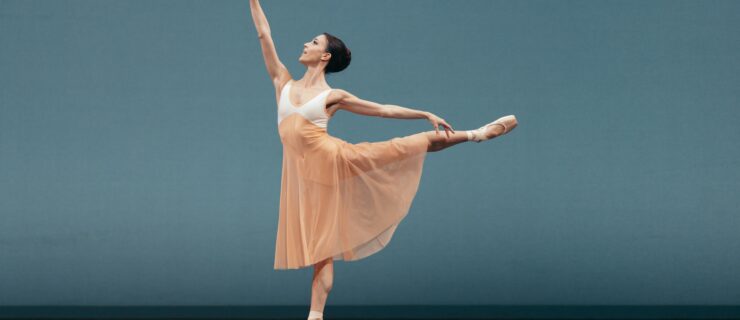
Something happens when you watch Pacific Northwest Ballet soloist Clara Ruf Maldonado perform: You find yourself leaning in as she draws you into the story. In Jean-Christophe Maillot’s Roméo et Juliette, which the company performed last spring, every expression reads from the tops of her eyebrows to the tips of her fingers. Her Juliette bursts with vivacity and passion, with currents of movement undulating through her limbs. Her love towards Romeo, danced by principal Lucien Postlewaite, feels genuine, and her agony at his death is guttural and raw.
“Clara has that special quality you can’t teach,” says PNB artistic director Peter Boal. “She’s just someone you watch and behold. Her body seems to breathe the music.”
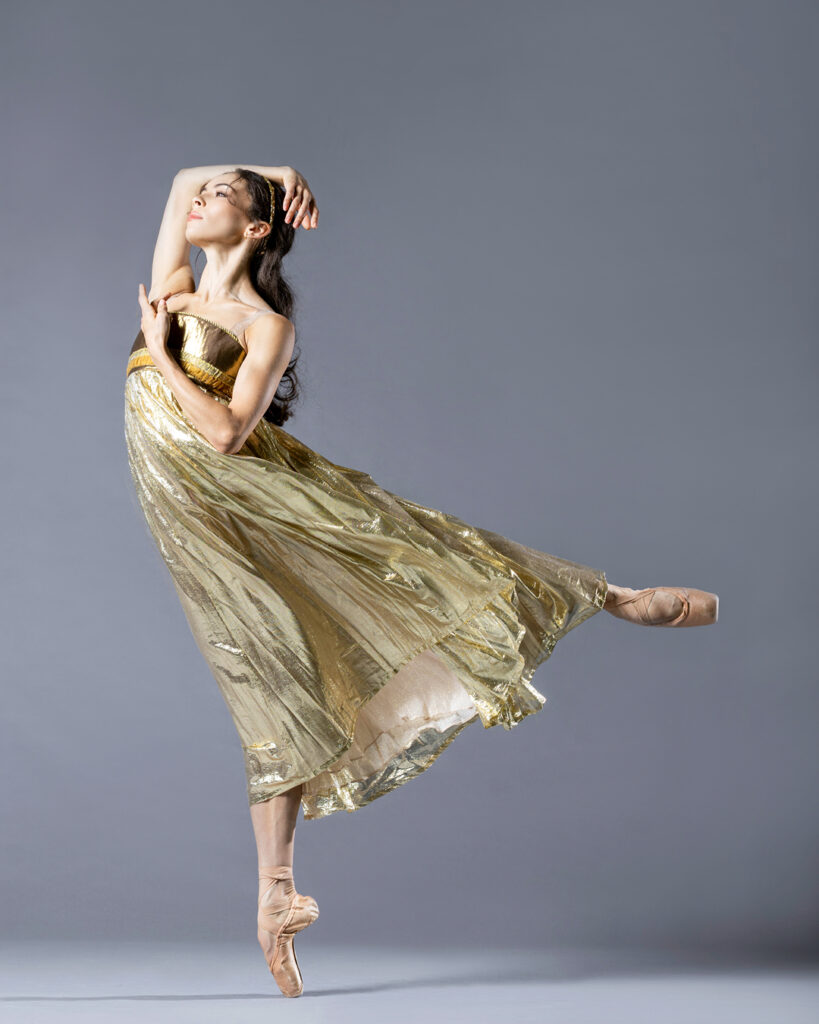
Ruf Maldonado’s Juliette was the capstone to a breakthrough season, which included principal debuts in The Sleeping Beauty and Balanchine’s Stravinsky Violin Concerto. Her impressive range is both stylistic and artistic; she can be both glamorous and quirky, classically demure and wildly inventive.
Ruf Maldonado’s current success is hard-won, born out of a quietly tenacious spirit and a willingness to dig deep. Early challenges and disappointments, which nearly derailed her career, only fed her determination. “Everybody wants to use her,” says Boal. “She’s on a beautiful trajectory right now, which is really fun to watch.”
Early Years
Raised in New York City’s East Village, Ruf Maldonado, 28, was born to art-loving and politically active parents. She did community theater as a child, along with violin and early ballet classes. Her parents enrolled her at the School of American Ballet at age 7. The following year, she was cast as Marie in New York City Ballet’s Nutcracker, where she watched ballerinas like Tiler Peck, Sara Mearns, and Megan Fairchild perform night after night.

Even so, she wasn’t yet cognizant of SAB’s place in the larger dance world. Around age 14, she noticed an influx of talented new classmates from other parts of the country, and felt the stakes get higher. Ruf Maldonado spent summers away at intensives, including two at the Pacific Northwest Ballet School. “I felt connected to PNB because I had a shared background, with the Balanchine training,” she says. The company was on her radar, but Ruf Maldonado, who’s just over 5′ 3″, didn’t think she’d have a chance because at the time its dancers skewed taller.
She instead focused on NYCB. She valued her training and teachers at SAB, particularly Kay Mazzo, then the school’s co-chair of faculty. “She understood me better than most,” says Ruf Maldonado. “I was pretty shy, and while I was a hard worker, I wasn’t pushy. I felt like she saw me and wanted me to succeed.”

A Setback
During her graduating year, Ruf Maldonado started struggling with a painful extra bone in her foot. “I tried to push through it, but it became too overwhelming.” She made the tough decision to have surgery and repeat another year at SAB, but worried about her timeline to join a company. “Being set back one year felt like 10.”
But she was ultimately glad to have a safe place to recover and keep dancing. By the fall of the following year, in 2015, she’d earned an apprenticeship with NYCB. Her ankle, however, continued to give her trouble; the extra bone had grown back, and she started compensating as a result. As NYCB’s season got underway, she developed a stress fracture in her fibula. “Your apprentice year is basically a trial period, and I wasn’t really able to dance,” says Ruf Maldonado. “It was the worst possible timing.”
The company extended her apprenticeship, but in the winter of 2017 she learned that she would not be advancing to the corps. “It was earth-shattering,” she says. “Growing up in New York and going all the way through the school, I lived in this little bubble. Then everything changed. I was crushed.”
She started thinking a ballet career wasn’t for her. As the NYCB season ended, she began giving away her leotards and pointe shoes, slowly making peace with potentially never dancing again.

Around the same time, an SAB staff member let her know that Peter Boal was guest-teaching, and encouraged her to take his class. “I thought, It’s an hour and a half of my life, I should just go,” says Ruf Maldonado. Afterwards, Boal, who remembered her as a standout during PNB’s summer programs, told her that while he didn’t have any openings, she should audition the following season. “I said, ‘I don’t think I’m going to dance anymore, so I probably won’t be back next year,’ ” Ruf Maldonado recalls. “I realize that’s a crazy thing to say, but I just had to be honest.”
Boal reached out about a month later: He could offer her a spot in the school’s professional division, with an apprenticeship for the following year. To his surprise, she said yes. “I didn’t hesitate,” Ruf Maldonado says.
Starting From Scratch
A few months later, she was back in Seattle, and back in dress code. She liked PNB, but without her support system, she struggled. “I thought traveling so far away would distance me from my experience in New York, but it didn’t,” she says. “I was just so aware of this big failure and felt so defined by it.”
She took her professional-division classes one day at a time. “As hard as it was, I felt so deeply that this was all happening for a reason,” she says. Boal stayed true to his word—six months later, she received her apprenticeship. Things were finally falling into place.
Her first rehearsals with the company, for William Forsythe’s One Flat Thing, reproduced—an avant garde contemporary ballet—proved pivotal. “It opened up a whole new dimension for me,” says Ruf Maldonado, who had never danced something that contemporary before. “I had so much fun dissecting the movement, studying the complexity of it, and playing with texture. I was finally engaged and passionate about something again.”

She shared a role with Noelani Pantastico, then a PNB principal. “My eye would always go to her,” says Pantastico. “She looked as if she danced with a story, in a piece that didn’t have one.” She felt moved to approach the young dancer after a rehearsal. “I said, ‘Clara, I don’t know what it is about you, but you dance with so much intention. You draw me in.’ ”
Growth Opportunities
Ruf Maldonado continued to thrive, and a few years later, in 2022, Boal gave her a major opportunity: Balanchine’s Duo Concertant, a pas de deux alongside fellow SAB alum Christopher D’Ariano. The role tapped into her Balanchine training; her favorite teacher, Kay Mazzo, who originated the role in 1972, went to Seattle to help stage it. “It was a full-circle moment,” says Ruf Maldonado.
The same program included Crystal Pite’s large ensemble work The Seasons’ Canon, and Ruf Maldonado was cast in a standout role that depicts how Pite herself sees the world. “This ballet has 54 dancers,” says Boal, “so it’s pretty important to be that one character that represents Crystal’s thinking.”
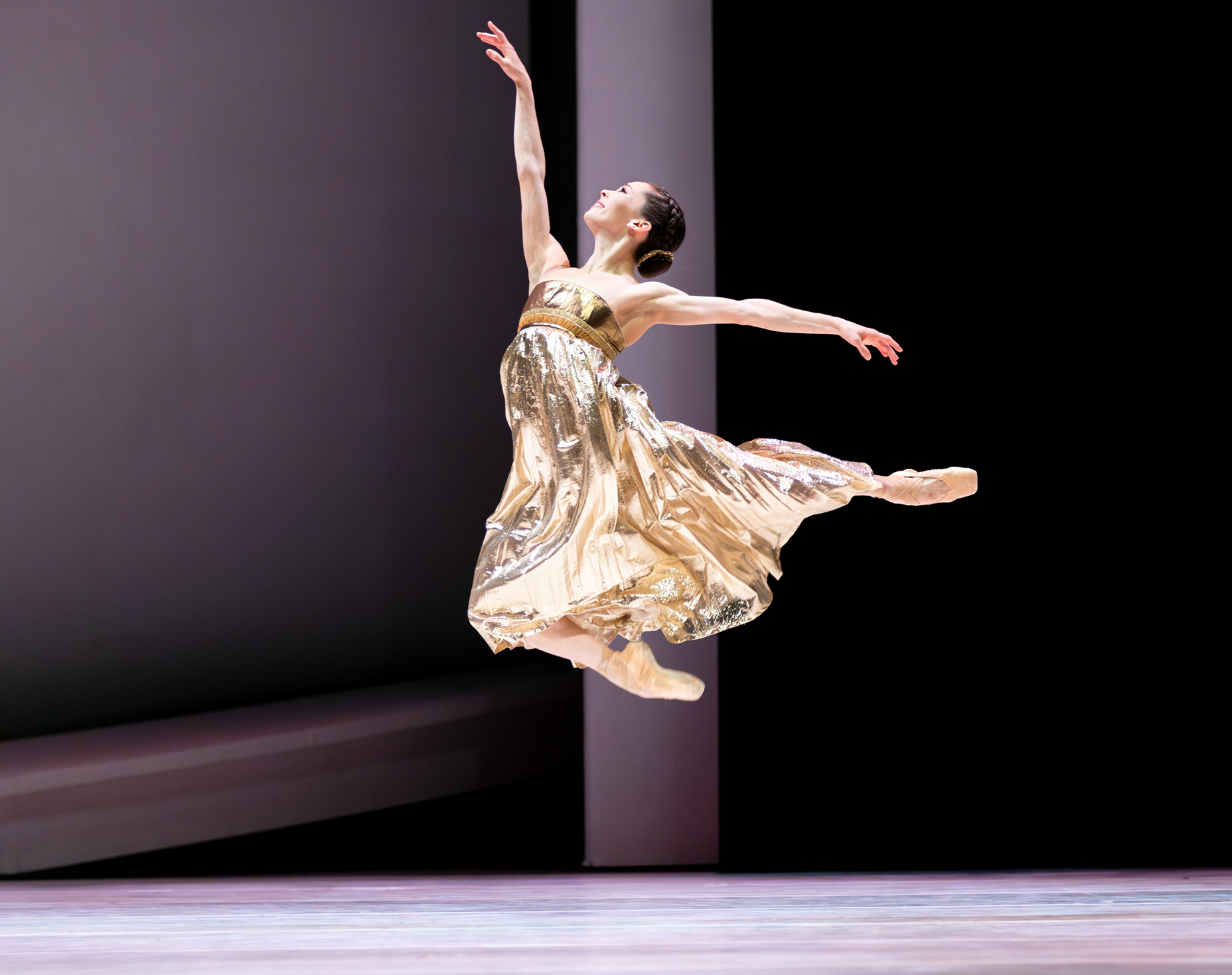
Ruf Maldonado in Jean-Christophe Maillot’s Roméo et Juliette. Photo by Angela Sterling, courtesy PNB. 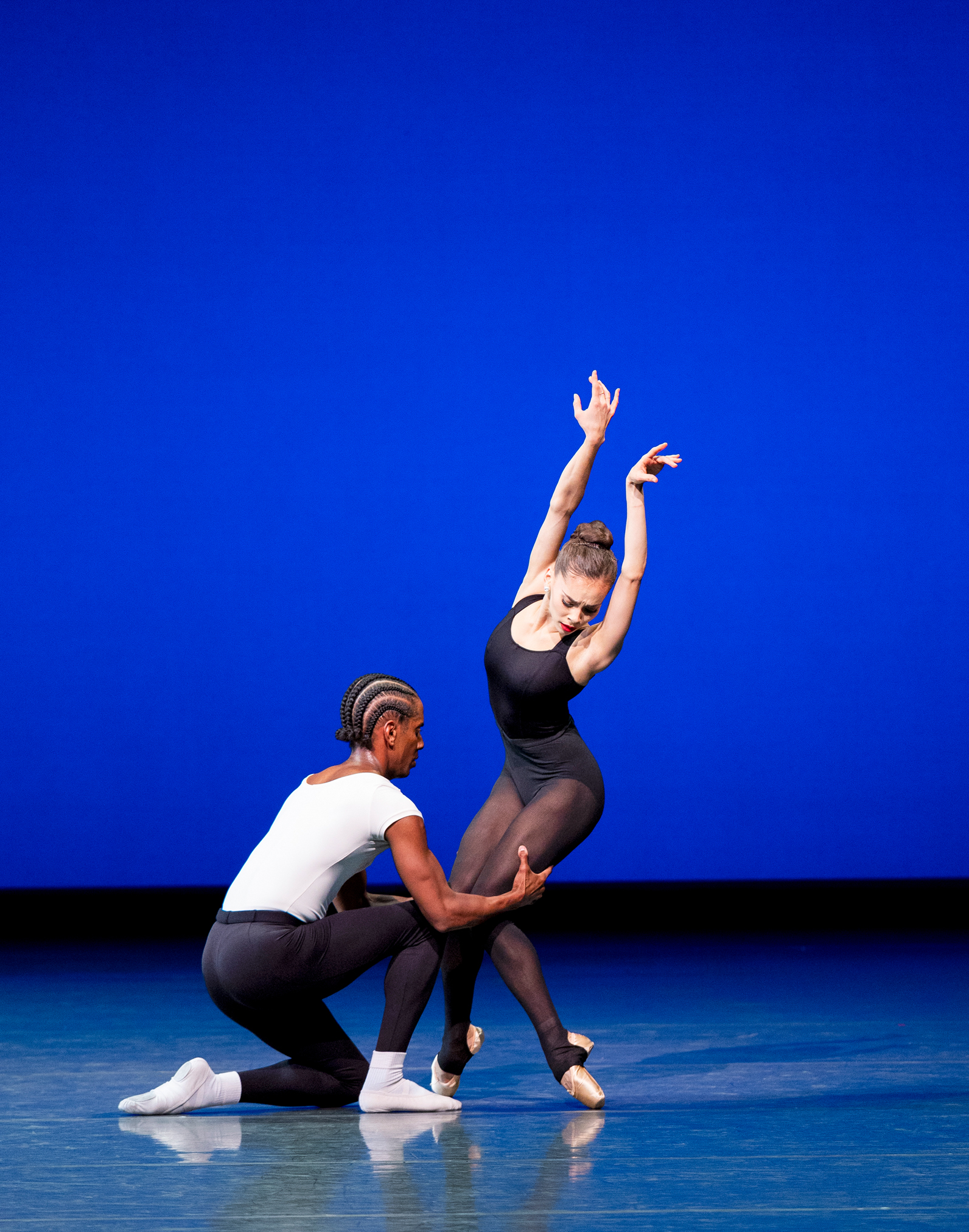
With Jonathan Batista in Balanchine’s Stravinsky Violin Concerto. Photo by Angela Sterling, courtesy PNB. 
In Crystal Pite’s Season’s Canon. Photo by Angela Sterling, courtesy PNB. 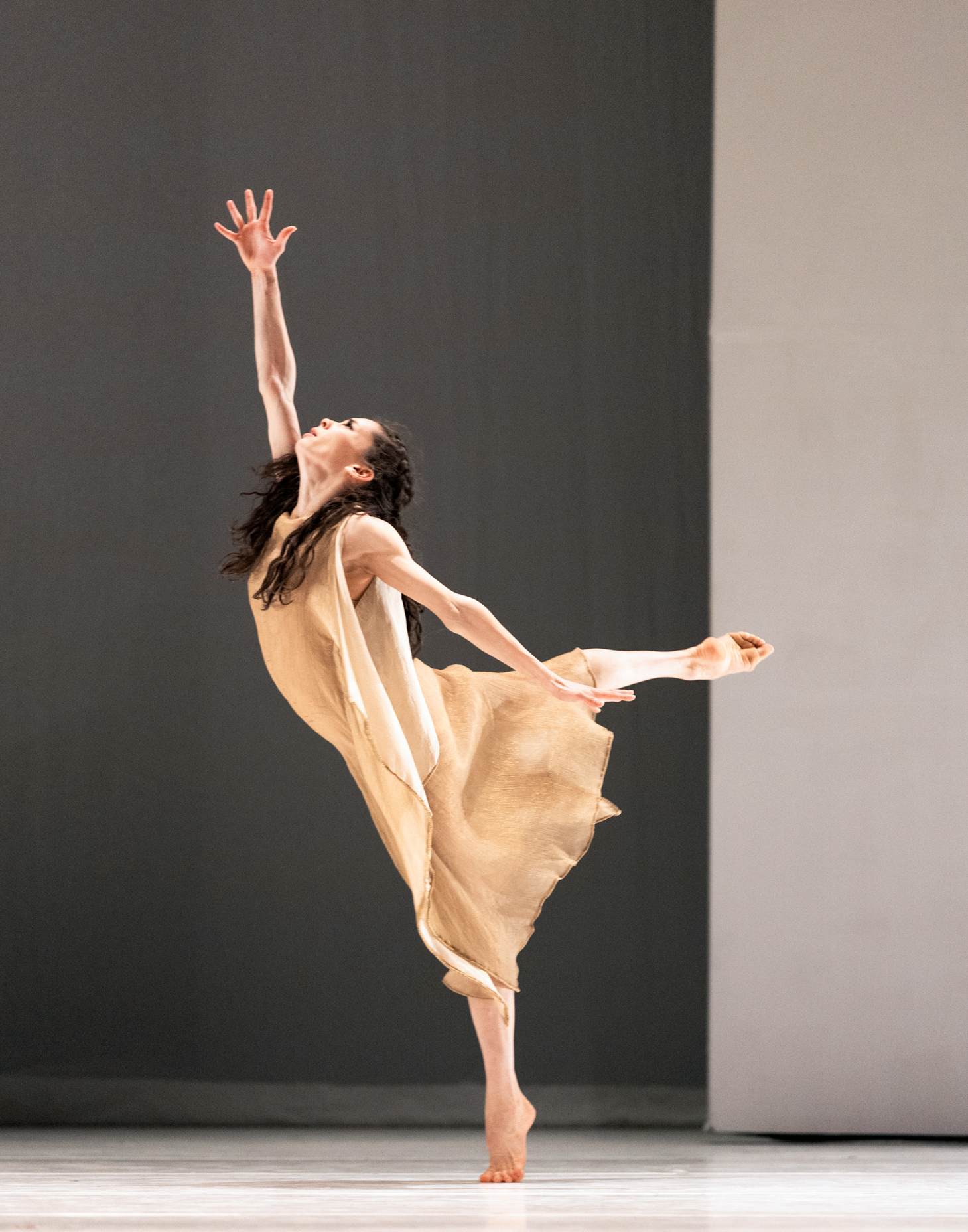
In Jean-Christophe Maillot’s Roméo et Juliette. Photo by Angela Sterling, courtesy PNB.
This particular program, which allowed Ruf Maldonado to explore her range, felt like another turning point. “One ballet was revisiting my past, but in this healing way, while the other was introducing me to my future,” she says. “I was so artistically fulfilled by both of them. I wasn’t being put in a box, and I was hungry to be this vessel for choreographers.”
Her repertoire continued growing, including featured roles in Jerome Robbins’ Afternoon of a Faun, Balanchine’s Nutcracker, Donald Byrd’s Love and Loss, and Pite’s Plot Point. In 2023, Boal promoted her to soloist.
Embracing Challenges
The 2024–25 season brought bigger challenges. In January, Ruf Maldonado took on Sleeping Beauty’s Aurora, one of the hardest roles in the classical canon. “She was totally ready, although I’m not sure if she saw it that way,” says Boal.
Ruf Maldonado, who considers herself more of an artist than a technician, admits she felt intimidated. “With Aurora, you’re so exposed—it’s just technique, strength, stamina. And her story arc is pretty surface.”
She realized that she had to commit fully to succeed: giving 100 percent in rehearsal, cross-training outside the studio, eating right, and getting plenty of sleep. “I dove in wholeheartedly, and started to really love the process,” she says. “At first I was a little uninspired by Aurora, but as we continued to work I realized that there’s a lot that she’s feeling. It was challenging to find the storytelling, but that made it more rewarding.”
The experience helped Ruf Maldonado realize how much she was capable of. Just a few months later, she would apply that same commitment to Juliette, her dream role. (“I’ve never wanted anything so badly in my life,” she says.)
Digging Deeper
Jean-Christophe Maillot’s Roméo et Juliette, a contemporary ballet version of Shakespeare’s play, requires raw emotional investment. “His style was like learning a new language,” says Ruf Maldonado. “His musicality is so different, and the choreography is so dense, with so many ideas in each step.”
Pantastico, who retired in 2022 and had performed the role numerous times, returned to PNB to stage the production. “With Juliette, you need to be vulnerable from the beginning to the end of the process—you need to open yourself up and allow yourself to know that you won’t always make the right decision.” Ruf Maldonado was more than willing to do that, Pantastico says, constantly questioning how much deeper she could go: “She’s not motivated by her ego. She’s motivated by serving the audience.”
Again, Ruf Maldonado leaned into storytelling. She read the play, identifying the character’s motivations and imagining how she herself would react in those situations. “I let that guide me, and just tried to respond as honestly as I could.”

As her responsibilities mount and a new season begins, Ruf Maldonado knows she needs to prioritize her physical health in order to manage the chronic pain she still experiences in her ankle. She works closely with her physical therapist, as well as Gyrotonic and Pilates instructors. “It’s daily maintenance.”
Outside of the studio, she lives a low-key life with her boyfriend (a fellow dancer) and her beloved beagle, Bob. “I hang out with Bob, go to the park, and try to make him happy, which seems like an impossible feat,” she jokes.
Looking ahead, Ruf Maldonado hopes to simply add more layers to her artistry. “I just want to keep exploring, keep diving in,” she says. “That’s all I can really ask for.”